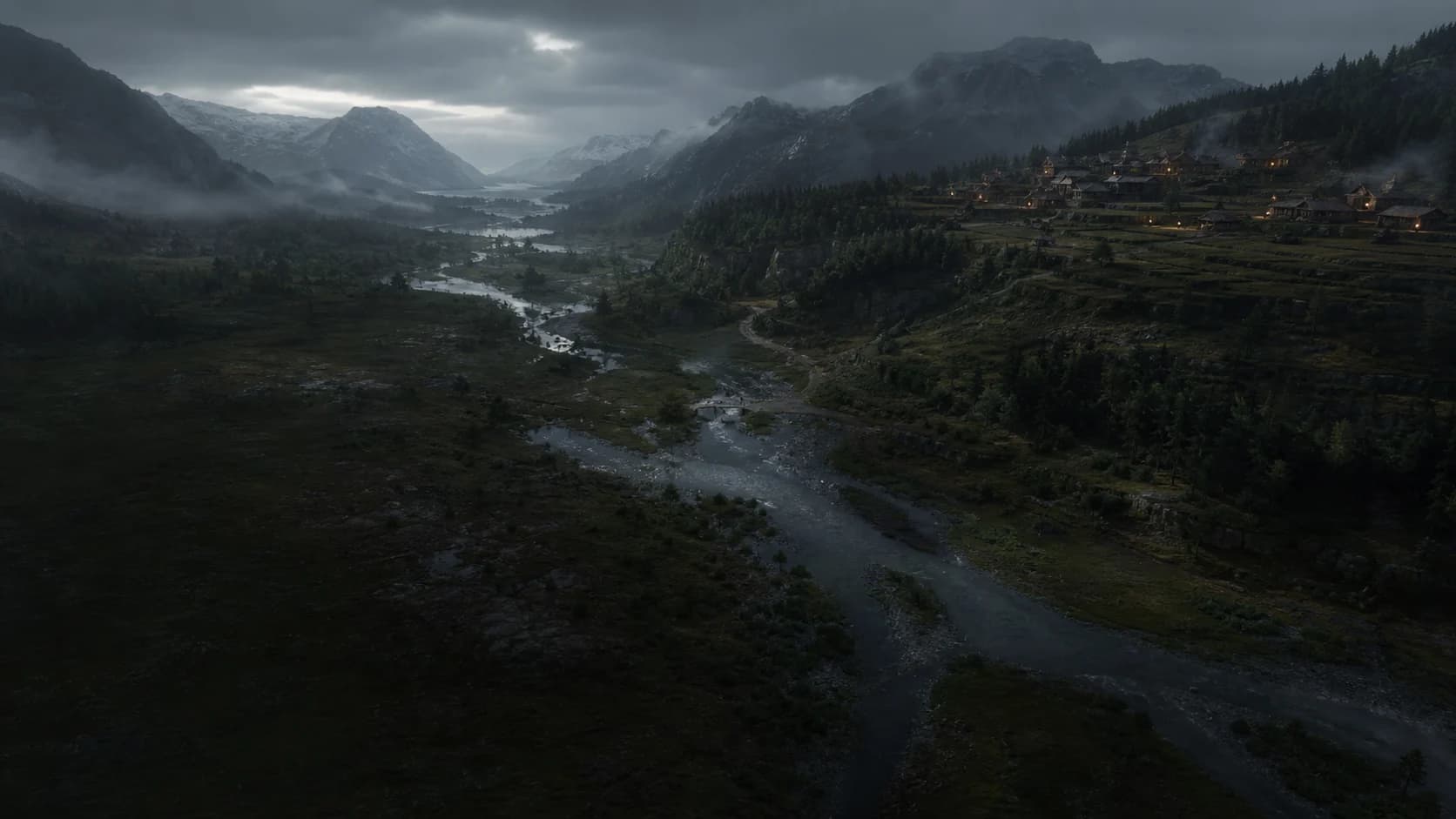
A plausible place
Hochwald Valley is fictional, but its geography belongs to the northern Alpine foothills. River terraces, wet lowland, mixed forest, clay, workable stone and narrow passes make settlement possible—and defense necessary.
The valley is not a blank map between chapters. Its slopes, water and approaches remain, even as roads harden, fields shift and the built ground grows denser.
Water, weather and access
The river is both an asset and a recurring constraint. It carries people and material, feeds wet meadows and workshops, and divides the ground whenever water rises. A short crossing can be more valuable than a large empty field if it remains usable under pressure.
Rain changes more than atmosphere. Mud slows movement, drainage protects stores, forest edges conceal an approach and high ground buys information. The valley asks the player to read conditions, not simply occupy space.
Ground that remembers
The easiest path through the mud may become a lane, a paved road, a rail corridor and later a service route. A wall line can outlive the wall itself. Drainage cut in one age changes where the next generation can build.
This persistence turns terrain into history. A useful decision is rarely temporary, and a neglected weakness can wait centuries to be tested again.
One valley, many readings
The meaning of the same ground changes with reach and organisation. A ridge that shelters an early village can become a siege platform, a signal position or the anchor for a sensor network. The geography stays fixed while the questions asked of it evolve.
That continuity is the heart of EVO. The player is never handed a replacement map to forget. Knowledge of the river, the pass and the vulnerable approaches becomes a form of inherited power.