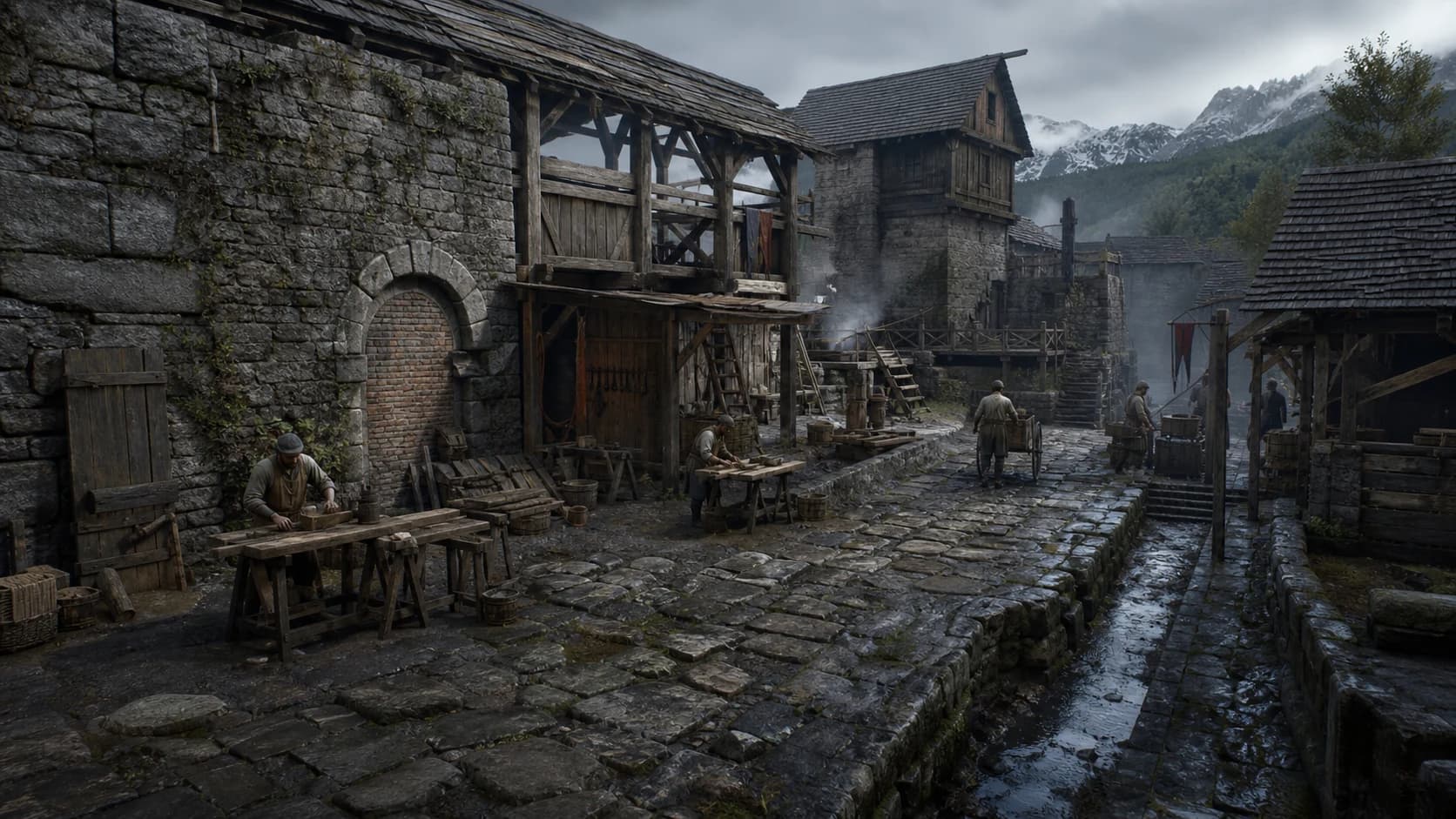
No clean slate
Buildings are expanded, refitted, repurposed, dismantled or left as ruins. The old structure remains legible inside the new one: an inherited foundation, a blocked doorway, a repaired breach, a yard whose shape no longer matches its use.
Advancing to a new age is therefore a construction project, not a visual reset. The settlement changes through work, disruption and deliberate choices about what deserves to remain.
Build, refit or let go
Not every structure deserves to survive unchanged. A useful hall can receive a stronger foundation, a workshop can grow around an older frame and an obsolete defense can become a road edge, a store or a deliberate ruin.
These choices give progress a physical cost. Space must be cleared, access maintained and essential work kept alive while the settlement transforms around it.
Tradition, not immortality
People do not live across millennia. Households, institutions and unit traditions do. A veteran formation carries a name, a reputation and hard-won knowledge into its successor, even when every person and piece of equipment has changed.
Continuity is therefore social as well as architectural. A gathering place, a route to water or the memory of a failed defense can shape behaviour long after its original builders are gone.
Ruins are decisions
Damage does not have to vanish. A burned threshold may be retained, a broken wall may define a yard and a dismantled industrial structure may leave foundations that later systems reuse.
The result is not a museum settlement. It is a working place whose layers reveal what the player protected, what they repaired and what they chose to leave behind.